Showing posts with label sci/tech. Show all posts

Tuesday, March 27, 2007

Dexter & Monty: the first robot comedy duo


Anybots's announcement video for their new robots, Dexter, the world's first (well, not really) dynamically balancing walking humanoid robot, and Monty, a wheeled robot with one fully articulated arm, is a very cool demonstration of their technology, but it's also really funny. To be specific, the bit where Monty pokes Dexter repeatedly to try and get him to fall over is *comedy gold*. Cracks me up every time I see it.

Technorati Tags: , ,

Read More...

Saturday, October 14, 2006

The next step in our cyborg future: thought-controlled bionic arms

Claudia Mitchell, a former US Marine, lost her left arm in a motorcycle accident in 2004. Today, she is a cyborg, fitted with a Bionic Arm developed by the Rehabilitation Institute of Chicago. The Bionic Arm is a bleeding-edge technology- a mind controlled prosthesis, the first of its kind. It will allow amputees to lead richer, fuller lives than they could with previously available prostheses.

As with many state-of-the-art research efforts, the bionic arm is strongly linked to the military- part of a multi-lab effort funded by $50 million from the Defense Advanced Research Projects Agency (DARPA). According to the Washington Post, as of July, 411 members of the (US) military serving in Iraq, and 37 in Afghanistan, have suffered wounds requiring amputation of at least one limb (no word on how many lost arms specifically). These men and women will be next in line to be fitted with Bionic Arms.

It is surely heartening to see military-developed technology alleviate, instead of cause, suffering, but a horrible possibility comes to mind of where this all might lead. Future advances in prosthetic technology might conceivably yield bionic limbs that are as good as, if not better, than natural human limbs. Imagine a war where soldiers lose limbs, only to go back into battle with new ones. The human body become expendable war expenditure.

Of course, this is worst-case scenario that is unlikely to come about anytime soon- it will take years for prosthetic technology to reach that point, and when it does, such artificial limbs will be very expensive indeed. The Bionic Arm itself costs between $60,000 to $75,000. This leads us to the grimmer reality- while US citizens can enjoy the fruits of such technology, who will provide Bionic Arms for the thousands of poor civilians in Iraq, Afghanistan and Vietnam (amongst other countries) who have lost their limbs to conflict? Where is their cyborg future? Perhaps it is overly-idealistic for me to say so, but I believe that they have an equal right to such technology as much as any soldier from a first-world nation.

Read More...

Sunday, October 08, 2006

Mars Rover Opportunity at Victoria Crater


HiRISE image of Victoria Crater

The Mars Rover Opportunity (whose exploits, along with that of it's twin, Spirit, I highlighted in this post back in March) is now exploring the 800-meter wide Victoria Crater- the largest crater that either of the Rovers has yet encountered. Opportunity has now been operating for over 960 days; 10 times it's expected lifetime! The Rover is now exploring the rim of the crater and will then descend into the crater itself, guided by the high-resolution images of Victoria Crater taken by the High Resolution Imaging Science Experiment (or HiRISE) on the Mars Reconnaissance Orbiter satellite. The combination of images from the Rover and the Orbiter are providing NASA with a wealth of scientific data on Victoria, which should reveal much about Mars' environmental history.

Read More...

Thursday, October 05, 2006

V.S. Ramachandran on the evolution of consciousness

"What is consciousness? This really breaks down into two questions: The first is the nature of qualia--how does the awareness of sensations like bitter, or painful, or red arise from the activity of neurons? The second: How does the sense of self—the person who experiences qualia—arise?"
Esteemed neurologist V.S. Ramachandran suggests what the answers to these questions might be in this brief article for the excellent Seed Magazine.

Read More...

Thursday, July 27, 2006

Byebye, Mr Banana?


The succulent, yellow fruits pictured above will be familiar to you as bananas, AKA the world's most popular fruit. To be very specific, they are 'Cavendish' bananas- the variety of banana most commonly sold in the West (it's not too uncommon here in the East, either :P). Unfortunately, that may not be the case in a few years time- the 'Cavendish' is being ravaged by disease and production may drop to the point where it's impossible to satisfy global demand.

The varieties of banana commonly eaten by man are, sadly, quite susceptible to disease. The reason for this is a fact that I myself wasn't aware of til a few days ago: the domestic banana plant is a clone! Genetic engineering is hardly a new science- farmers, through their selective breeding, have been doing it since time immemorial. Our domestic plants and animals have all been changed significantly from their wild counterparts through human efforts. Likewise, the domestic banana has been selected for a trait that makes it's fruit edible to us- namely, a distinct lack of seeds.

I've always wondered why bananas have no seeds and how the heck the tree reproduces. Well, I've found my answer. New banana plants are commonly grown by planting young offshoots of an existing banana plant. The new plant, then, will be a genetic clone of the plant it was propogated from. It is this practice that has allowed the spread of identical-tasting banana plants from Southeast Asia to Africa and the Americas- ensuring that everyone gets to eat the same great-tasting and nutritious fruit.

On the flipside, this also means that there's precious little genetic variation amongst the domestic varieties of banana- hence their remarkable lack of resistance to disease. What affects one banana plant can and will affect all other banana plants of the same variety. History has proved this fact- a 'banana apocalypse' has already happened once. The 'Gros Michel' variety of banana was once the favoured variety sold in the Western world until it was hit by a fungus called Panama disease in the early part of the 20th century. By mid-century, the production had been crippled. After it was clear that there was no way to save the 'Gros Michel', the 'Cavendish'- resistant to Panama Disease- entered the picture as it's replacement.

Unfortunately for us, the wild fungi weren't as genetically-static as the bananas they attacked. In 1992, a new strain of Panama Disease (called Race 4) that could affect 'Cavendish' varieties was discovered. It has since wiped out many plantations in Southeast Asia. It seems certain now that 'Cavendish' will suffer the same fate as 'Gros Michel' before it. All isn't lost, however. This fascinating Popular Science article details efforts by two groups of people to create a new, resistant form of banana: farmers who are trying to create a replacement plant similar enough to 'Cavendish' that consumers won't notice (or rather, mind) the difference and bioengineers who are manipulating the plant's genes to create a hardier, disease-resistant form of 'Cavendish.' Both groups have their work cut out for them; particularly the farmers, as new banana hybrids are hard to grow.

While the loss of the 'Cavendish' will certainly be a loss for banana-growing economies and fruit-lovers everywhere in the developed world, there is an even more pressing issue at hand. Bananas are a staple food in many parts of Africa and even though it is not the 'Cavendish' but other varieties that are commonly grown in many African countries, they too are under threat from the same diseases. The loss of the fruit would be no laughing matter for the millions of people who rely on it as a primary source of nutrition. Finding a solution to the banana's woes is thus a matter of utmost importance.

Technorati Tags: , , , ,

Read More...

Tuesday, June 27, 2006

Electric cars- not quite dead

A few weeks ago, my sister showed me a cool trailer for a documentary called "Who Killed the Electric Car?"- an examination of the life and death of General Motor's pioneering electric car, the EV1. Released in 1996, the car was fast, efficient and a big hit with the select group of people who drove the car. Sadly, the EV1 line of cars was discontinued in 2002 and commercial development of electric cars in America seems to have died with it.

However, electric vehicle enthusiasts are a passionate lot and it looks like the fate of the electric car isn't quite sealed yet.

Behold the Eliica:

Developed in Japan by Professor Hiroshi Shimizu and his team at Keio university, this 8-wheeled beast of a machine can accelerate from 0 to 100km/h in under 4 seconds- faster than a Porsche 911 Turbo- and has a top speed of 370km/h. UK motoring magazine Auto Express reports that the car is both speedy and fun to drive- it's lack of a transmission means that it can accelerate smoothly with no jerks between gears. The prototype car has been in development for quite a few years and was recently officially unveiled at Togu Palace with the Crown Prince and Princess in attendance. The team intends to produce at least 200 units of the car once they receive corporate sponsorship.

As cool as the Eliica is, it's mostly intended as a demonstration of power- proof that electric cars aren't the slow, cumbersome vehicles that they're popularly perceived to be. Back in the USA, however, some enterprising companies are planning to bring electric cars to the commercial market- in a big way.

One of those companies is Wrightspeed, with their Wrightspeed X1- the fastest electric car in the world and one of the world's fastest cars, period.

This speed demon beat both a Ferrari 360 Spider and a Porsche Carrera GT in a quarter-mile drag race (which you can watch here!), going from 0-60mph (or 96.6 km/h) in approximately 3 seconds. Entrepreneur Ian Wright is the man behind the X1 and he's got a plan to turn the current prototype into a production car for the high-end speedster market.

Interestingly enough, Ian Wright's background is in information technology (he's engineered routers and switches for companies like Cisco in the past)- according to this Business 2.0 article, he's part of a new wave of Silicon Valley upstarts (see also: Tesla Motors, who have bold plans and the venture capital to back them up) who intend to do what existing automobile makers have been failing at for years- bring an electric car to the mass market. They believe their technological expertise will enable them to design the highly-complex electronics and battery systems that will drive the electric cars of the future.

Speaking of batteries, they are commonly cited as the biggest problem with electric cars (as well as the main reason for them never taking off) as they're still too expensive and don't deliver the desired level of performance. However, a few start-ups down in Silicon Valley are working on just this problem and claim that big advances are on their way that will drive prices down significantly while improving performance to acceptable levels. With oil prices soaring sky-high and unlikely to ever come back down significantly, the time may finally be right for the electric car!

Read More...

Saturday, June 17, 2006

Nature Magazine on the Future of Computing

In this web feature, Nature Magazine examines how computer science techniques and concepts may transform mainstream science by 2020. Amongst other things, they look at quantum computers, ubiquitious computing and most interestingly, the Internet as a 'creativity machine.'

Read More...

Friday, March 31, 2006

Rocketboom interviews Bruce Sterling about spimes!

The latest Rocketboom's got a short but very informative interview with Bruce Sterling about spimes. He starts by explaining how it might be useful to take a shoe and embed an RFID tag with a record of what it's made of- instead of throwing it away when you're done with it, you could sell it as raw materials. Then he handles the privacy issues inherent in such an idea- basically, he agrees that spimes do have a great deal of "abuse potential" but he also argues that spimes' potential for good outweighs the bad. Good stuff. Check it out.

Read More...

Steve Yegge on Math for Programmers- again!

More than a year after he wrote a blog post titled Math Every Day- the same one I found 2 weeks ago- Steve Yegge's written a follow-up post on a new blog he's started (check it out- it's interesting!). He's got a few cool ideas, based on his experiences. For one thing, he thinks maths is taught all wrong in schools. He thinks schools spend too much time teaching students the details of a few branches of maths- because of that, we never figure out how it all fits together. The Bigger Picture, so to speak. His says that acquiring a broader knowledge about math is far more useful (and why? In Yegge's words: Because the first step to applying mathematics is problem identification.) and suggests Wikipedia as a tool to this end. I think he's onto something here!

Read More...

Thursday, March 30, 2006

Check out Bruce Sterling's 2 latest speeches online!

Bruce Sterling, I can attest, is an amazing speaker. Probably even better than he is a writer, and he's an extremely good writer. He gave two speeches recently that are well worth checking out.

The first, at the O'Reilly Emerging Technologies Conference, was all about spimes- objects that can be tracked through time and space, online. An Internet of Things, he calls it. That's an eyebrow-raiser, isn't it? Here's what the man has to say about it:

Why would we want to do such a weird thing? Mostly so that we can engage with objects better during their lifecycle, from the moment of invention to their decay. That's the technical reason, the design reason: but the real reason would be because of how that would feel.

"The primary advantage of an Internet of Things is that I no longer inventory my possessions inside my own head. They're inventoried through an automagical inventory voodoo, work done far beneath my notice by a host of machines. So I no longer to bother to remember where I put things. Or where I found them. Or how much they cost. And so forth. I just ask. Then I am told with instant real-time accuracy.

"I have an Internet-of-Things with a search engine of things. So I no longer hunt anxiously for my missing shoes in the morning. I just Google them. As long as machines can crunch the complexities, their interfaces make my relationship to objects feel much simpler and more immediate. I am at ease in materiality in a way that people never were before."
The rest of the speech is chockful of visionary design concepts and ideas so go ahead and read a transcript or, if you've got the time, listen to an edited MP3 of his speech.

The second speech, a keynote address at the South by Southwest Interactive Festival, was on the more general topic of The Future- where we're heading and how to create a better world. WorldChanging sums it up nicely thus:
The challenge, Bruce says, is that the worst people in the world -- genocidal ethnic mafiosos, fundamentalist fanatics, Washington lobbyists -- are running the show, American government has become the new Soviet Union (ossified, corrupt and widely perceived as illigitimate by the rest of the planet) and things are not good in much of the world. That said, if you look honestly at the world, you see a new story emerging, with millions of smart, dedicated people locked in a struggle to steer us towards a better future using every tool in their power, and that "that's a big story!" Finally, he reminds those of us who are part of that story of the motto of the old Soviet-era Eastern European dissidents: "Make no decision out of fear."
I listened to the MP3 last week and damn if it wasn't the best speech the man's ever given- alternately heady, intellectual, passionate, moving and powerful. ! I've been waiting for someone to put up a transcript and a blogger by the name of Sean Harton has kindly obliged- though you really, really should listen to his entire speech. It's just that good.

Read More...

Wednesday, March 15, 2006

From von Neumann to Ada- the origins of Computer Science

Last week I stumbled upon a blog entry written by Steve Yegge, a former software developer at Amazon.com who now works for Google, titled Math Every Day. In it, he discusses how reading a book called John von Neumann and the Origins of Modern Computing made him realise how important Maths is, especially to programmers, and how a lack of practical Maths knowledge hindered his expertise as one. So he embarked on a program to learn (or rather, re-learn) a bit of Maths everyday for one year.

In his lengthy post, he also details some of John von Neumann's spectacular achievements. Originally a mathematician, von Neumann co-created Game Theory, was a key member of the Manhattan Project that created the first atom bomb, contributed to the field of quantum mechanics, created the field of cellular automata and oh yes, invented the modern computer (in fact, most computers in use today are designed according to an architecture that bears his name). With a resume like that, it's no wonder that John von Neumann is considered one of the greatest geniuses of the 20th century.

Fascinated by the story of this man, I did a bit of googling and found the online text of Tools for Thought, a history of modern computing that focuses on some of the key figures in the field. The book's written by Howard Reingold- who also wrote the critically-acclaimed book Smart Mobs, about the impact that pervasive computing will have on society. The blog associated with the book is one of the best on the Internet.

I read the first chapter of Tools for Thought, which tells the story of Charles Babbage, who invented the world's first working digital computer- the steam-driven Difference Engine, and Ada Lovelace, the daughter of the infamous Romantic poet Lord Byron (author of, amongst other works, Don Juan) and one of the world's first programmers.

Having read that much, I wanted to read more about all these visionaries who stood at the brink of the Age of Information in which we now live. So the next day at the NUS Library, I searched for books on the history of computing and found two rather interesting ones. The first, The Bride of Science: Romance, Reason, and Byron's Daughter, was a biography of Ada Lovelace, which I'm currently reading.

Far from a dry text, the book starts off by detailing the tumultuous romance between Ada's mother- the supremely logical, rational and scientifically-minded Annabella Milbanke- and George Byron- poet, lover, celebrity, a man who would come to symbolize the Romantic movement evermore and become the model for the now-stereotypical Romantic hero.

The book presents Ada as thus being borne of a union between the increasingly-incompatible philosophies of Scientific Rationalism and Romanticism. She would inherit both the wild passions and cold logic of her father and mother, respectively. Set in the backdrop of the emerging industrial Victorian age, her story is one that would quite possibly be considered too outlandish for a work of fiction, and so is yet more remarkable for being true.

The other book I borrowed is Prisoner's Dilemma by William Poundstone. The book is partly a biography of John von Neumann and partly a history of game theory, that branch of mathematics that he helped create. I haven't read it yet, but it comes highly recommended and looks pretty cool.

I personally find that learning about the history of a field- Computing, in this case- and the personalities who helped shape it is far more interesting than simply learning theory without being able to ground it in any kind of context. Pretty much the same goes for Physics, which can seem awfully abstruse to the casual observer but has always been one of the most exciting branches of science, populated as it is by a set of individuals as eccentric as they are brilliant.

Read More...

Exploring Mars!

The past few years have been really exciting for Mars exploration. NASA launched the Spirit and Opportunity Mars Exploration Rovers in June and July of 2003 and both landed successfully on the planet in January 2004. Both Rovers have far exceeded their original 90-day life spans (by about 7 times, actually!) and have been transmitting valuable scientific data back to their controllers here on Earth- most notably evidence from Opportunity that it's landing site may have once been a lake or a sea.

On August 21st 2005, Spirit ended a year-long climb up the 82-meter high Husband Hill, part of the Columbia Hills range- a truly Herculean feat for the golf-cart sized Rover.


The view from the top, baby!

The "little rover that could" then descended from the hill and in February 2006, arrived at a site called Home Plate (so named because it resembles the home plate of a baseball diamond when seen from orbit) and is now heading towards McCool Hill, now estimated to be the highest hill in the Columbia range.

Meanwhile, Opportunity's been keeping busy too. In January 2005, it discovered Heat Shield Rock- the first meteorite found on another planet! It's since passed by several craters, dug several trenches, gotten stuck in a sand trap, successfully escaped from said trap and is currently studying Erebus Crater. The Rovers have been, and continue to, a remarkable success for NASA- heck, there's even an IMAX movie about them now- but they haven't been resting on their laurels.

I was just watching a video of a talk given by Pete Theisinger, manager of the Mars Exploration Rover project, at the Computer History Musuem. During the talk, he described the challenges he and his team faced in developing the two Rovers in just three years (it's quite fascinating to watch!) and along the way, he related that in 2000, NASA had initiated two competing pre-projects- the Rover and and an Orbiter pre-project. Of course, the Rover project went ahead first- the Orbiter project was pushed back.

The Mars Reconnaissance Orbiter, as it is now known, launched in August 2005 and on 10 March, 2006, successfully put itself in orbit around Mars! It's equipped with the most powerful telescopic camera ever flown on a planetary mission and should provide us with the most detailed views of the planet's surface we've ever seen.

While we wait for the craft to send it's first images of Mars, we can take a look at a new map of the red planet online, courtesy of Google! They launched their new Google Mars site on 13 March 2006 to commemorate the birthday of 19th century astronomer Percival Lowell, who created a map of the planet and was also instrumental in the search for a planet beyond Neptune (Pluto, discovered in 1930, 14 years after his death).

Read More...

Monday, March 06, 2006

Better batteries for a better world

Worldchanging is one of the coolest blogs on the Internet. In the words of their about page, the site is built around the premise that "the tools, models and ideas for building a better future lie all around us." Since October 2003, the good folk who run the blog have been posting links and analyses of such tools, models and ideas. The blog is thought-provoking, insightful and very informative. In a world where we're bombarded by news of death and disaster practically every day, it's good to take a step back and think about how we could try and improve the future.

A recent post on Worldchanging talks about batteries. They might not seem like the most exciting, world-changing sort of technology, but advances in battery technology will help to make electric cars (and other forms of electric transportation) a more viable alternative to gasoline-fueled cars and drastically improve the amount of lifetime of mobile devices (Worldchanging has highlighted the roles of handphones in particular as important environmental, developmental and political tools).

The post focuses on 5 new battery technologies, which range from improvements in lithium-based battery technology that will make them more stable, cheaper and more spacious than existing lithium-based batteries, to a new ultracapacitor that promises drastically improved storage capacity- something that will greatly benefit manufacturers of hybrid and fuel-cell cars which rely on ultracapacitor technology.

If you want to see more of how bleeding-edge technologies can be used to improve the world, head on down to Worldchanging. You won't be disappointed.

Read More...

Sunday, March 05, 2006

Remote-Controlled Shark Spies

According to a New Scientist article, a DARPA-funded research team has developed an implant that allows for a shark's brain signals to be "manipulated remotely." In other words, they're mind-controlling sharks. The Pentagon wants to use them as stealth spies. OK... we're moving squarely into James Bond/Austin Powers territory now. Weird.

The same New Scientist article goes on to give an example of another research team that used a similar technique to guide rats through piles of rubble. The New York Police Department is considering recruiting those rats to their Disaster Response Team to detect bombs or trapped people. That's really cool. Cooler than shark spies, at any rate.

Oh and it looks like all this research that's going into manipulating animal brain signals may actually help create prostheses to restore movement to nerve-damaged, paralyzed limbs. Nice. The New Scientist article's got tons more details, so check it out if this is your kinda thing.

Read More...

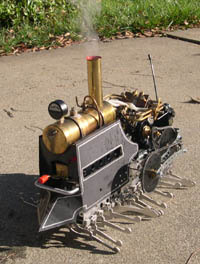
Steam Robots!

Crabfu's R/C steam-powered robots are wicked cool. His Loco-Centipede is probably the single coolest R/C toy I've ever seen.


Now this is steampunk!

Read More...

Monday, February 27, 2006

Autobots, Transform!

Everybody loves Transformers. But a Mr. Nakamura over at Himeji Soft Works in Japan actually built one that's going to take part in the International Robot-One Competition in Korea next month. I think it's going to be very popular there! Watch the video- I'm sure you'll agree.


(via Robot-Dreams.com)

Read More...

Spaceport Singapore

A pioneering space tourism company called Space Adventures (the same guys who organised Dennis Tito's- the first space tourist who paid his way to space- trip to the International Space Station) is collaborating with Singapore to build a Spaceport right here in Singapore! According to the official site, the spaceport will offer suborbital space flights, zero-G flights, simulated space walks, space camps and astronaut-for-a-day programmes. The suborbital flights are the main attraction, though Channel Newsasia reports a ticket on one of those will set a traveller back a cool hundred thousand US dollars. Ouch. Clearly, space travel is still going to be for the super-rich for a while (the rest of us can just go on simulated space walks, I suppose *sighs*) but I'm still really enthused about this development! Private initiatives like this spaceport will eventually drive down the cost of space travel- I'm confident that within 20 years, space travel will hit prices that are more-or-less affordable for the common (upper-middle class) man. Or woman, for that matter. And space travel isn't just a vanity thing for rich folk, either! Besides giving people the opportunity to witness the beauty of our planet from space, commercial space flight will eventually let us make suborbital flights around the globe (you can travel anywhere on the globe in just 45 minutes that way!) and even travel to the moon- again! If you've got even one adventurous bone in your body, then that's just bloody exciting.

Read More...

Monday, February 20, 2006

Superhero suits in real life!

Right-o. So it seems that a company called d3o lab's making futuristic material, called d3o (doh!), that's lightweight, bendable and stiffens on impact, effectively turning into a form of body armour. A clothing company called Spyder's making ski suits made of this material- and apparently the US and Canadian ski teams are loving it. Awesome stuff. I'm willing to bet the designs of Spyder's d3o suits were inspired by Spider-Man's suit. They look pretty cool, don't they? Now if only they would make some for hot weather. ;-)

Read More...

Monday, February 06, 2006

Netgear Router Woes

Bought a Netgear WGR614v5 Wireless router the week before last to replace a Linksys router that was giving me a fair bit of grief- for goodness sake, I had to restart it every 3 days cos my connection kept dropping out on me. The Netgear one doesn't do that- well it better not!- but it does this really weird thing where I get "Server not found" errors on a lot of pages when I first start a browsing session. Browsing feels a little slow in general. This bothered me so much that I actually contacting Netgear's tech support- sadly they don't have a Singapore tech support line so I got through to a call-center in India. A friendly Indian dude ran me through a whole set of trouble-shooting questions and after about half an hour told me to update my routers firmware to the latest version. Which I did. But it doesn't seem to have alleviated the problem. This is severely uncool. I'm gonna call em back but somehow I doubt the service guys'll be of much more help- I suspect I'm going to have to turn this thing in and get a replacement. But I'd really appreciate any help/advice that kind netizens out there could offer.

Oddly enough, I've never used a wireless router that DIDN'T give me all kinds of problems. And I've been using Linksys- supposedly the best brand in routers- routers up til now.

Read More...

Thursday, October 27, 2005

I want one of these!

Nippon Telegraph & Telephone (NTT) Corp has developed a device that lets you remote-control humans!

Don't panic just yet- it's not a mind-control device. What they've developed is a special headset and remote control combo. The headset sends a low-voltage electric current from the back of your ears through your head in either a left-right or right-left direction- as set by the remote control. When the remote switch is set to right, you'll be compelled to turn right when walking (apparently you can resist but then you'll have to stop moving altogether).

NTT envisions a range of uses for this technology, from games(!) to amusement park rides to music. Defence contractors, on the other hand, are already envisioning ways to use this as a "non-lethal" weapoon.

Now if they could make a device that works without the intended controllee having to wear a headset, it'd make for the ultimate prank device! Oh, the possibilities!

Read More...