Showing posts with label sociopolitics. Show all posts

Tuesday, May 01, 2007

Happy May Day!

Up til now, I haven't paid any attention to May Day/Labour Day- it doesn't stand out among the numerous holidays we celebrate in Singapore, and it always seemed like an oddly ironic holiday to celebrate in a country that doesn't have a labour movement. However, as I am now a member of the workforce, I thought to educate myself as to what this holiday is all about. Turns out that this isn't just a holiday celebrating the efforts of the working class- its roots lie in an international movement to institute an eight-hour working day for all workers. So take a moment to read about the of the 19th and 20th century labour unionists who fought the good fight so that we can enjoy what is now considered a basic right in modern democratic societies worldwide.

Technorati Tags: ,

Read More...

Wednesday, November 01, 2006

A Message of Hope from the Banker to the Poor

"The one message that we are trying to promote all the time, that poverty in the world is an artificial creation. It doesn't belong to human civilization, and we can change that, we can make people come out of poverty and have the real state of affairs. So the only thing we have to do is to redesign our institutions and policies, and there will be no people who will be suffering from poverty. So I would hope that this award will make this message heard many times, and in a kind of forceful way, so that people start believing that we can create a poverty-free world. That's what I would like to do."
Muhammad Yunus in a telephone interview with the Nobel Foundation.
Technorati Tags: ,

Read More...

Saturday, October 14, 2006

The next step in our cyborg future: thought-controlled bionic arms

Claudia Mitchell, a former US Marine, lost her left arm in a motorcycle accident in 2004. Today, she is a cyborg, fitted with a Bionic Arm developed by the Rehabilitation Institute of Chicago. The Bionic Arm is a bleeding-edge technology- a mind controlled prosthesis, the first of its kind. It will allow amputees to lead richer, fuller lives than they could with previously available prostheses.

As with many state-of-the-art research efforts, the bionic arm is strongly linked to the military- part of a multi-lab effort funded by $50 million from the Defense Advanced Research Projects Agency (DARPA). According to the Washington Post, as of July, 411 members of the (US) military serving in Iraq, and 37 in Afghanistan, have suffered wounds requiring amputation of at least one limb (no word on how many lost arms specifically). These men and women will be next in line to be fitted with Bionic Arms.

It is surely heartening to see military-developed technology alleviate, instead of cause, suffering, but a horrible possibility comes to mind of where this all might lead. Future advances in prosthetic technology might conceivably yield bionic limbs that are as good as, if not better, than natural human limbs. Imagine a war where soldiers lose limbs, only to go back into battle with new ones. The human body become expendable war expenditure.

Of course, this is worst-case scenario that is unlikely to come about anytime soon- it will take years for prosthetic technology to reach that point, and when it does, such artificial limbs will be very expensive indeed. The Bionic Arm itself costs between $60,000 to $75,000. This leads us to the grimmer reality- while US citizens can enjoy the fruits of such technology, who will provide Bionic Arms for the thousands of poor civilians in Iraq, Afghanistan and Vietnam (amongst other countries) who have lost their limbs to conflict? Where is their cyborg future? Perhaps it is overly-idealistic for me to say so, but I believe that they have an equal right to such technology as much as any soldier from a first-world nation.

Read More...

Thursday, October 05, 2006

Jon Stewart on Habeas Corpus

The United States Senate has passed a bill that will deny suspected terrorists the right of habeas corpus (aka the right to seek release from unlawful imprisonment). Here's what comedian Jon Stewart has to say about all this, along with an educational (:p) look at the English justice system 900 years ago:


Read More...

Monday, September 11, 2006

Project Censored's Top 25 Censored News Stories

Every year, Project Censored compiles a list of "25 news stories of social significance that have been overlooked, under-reported or self-censored by the country's major national news media."

This year's list:

#1 Future of Internet Debate Ignored by Media
#2 Halliburton Charged with Selling Nuclear Technologies to Iran
#3 Oceans of the World in Extreme Danger
#4 Hunger and Homelessness Increasing in the US
#5 High-Tech Genocide in Congo
#6 Federal Whistleblower Protection in Jeopardy
# 7 US Operatives Torture Detainees to Death in Afghanistan and Iraq
#8 Pentagon Exempt from Freedom of Information Act
#9 The World Bank Funds Israel-Palestine Wall
#10 Expanded Air War in Iraq Kills More Civilians
#11 Dangers of Genetically Modified Food Confirmed
#12 Pentagon Plans to Build New Landmines
#13 New Evidence Establishes Dangers of Roundup
#14 Homeland Security Contracts KBR to Build Detention Centers in the US
#15 Chemical Industry is EPA’s Primary Research Partner
#16 Ecuador and Mexico Defy US on International Criminal Court
#17 Iraq Invasion Promotes OPEC Agenda
#18 Physicist Challenges Official 9-11 Story
#19 Destruction of Rainforests Worst Ever
#20 Bottled Water: A Global Environmental Problem
#21 Gold Mining Threatens Ancient Andean Glaciers
#22 $Billions in Homeland Security Spending Undisclosed
#23 US Oil Targets Kyoto in Europe
#24 Cheney’s Halliburton Stock Rose Over 3000 Percent Last Year
#25 US Military in Paraguay Threatens Region

For details on each item, go here.

(again, via BoingBoing)

Read More...

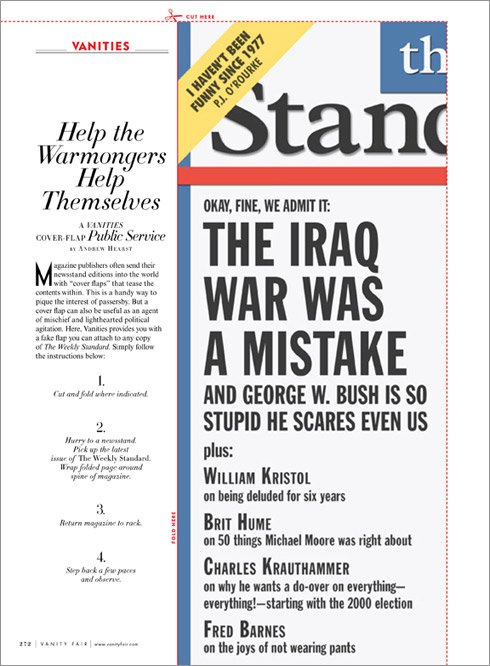
Vanity Fair punks neocon magazine The Weekly Standard


The October 2006 issue of Vanity Fair magazine comes with a fake cover flap for the neoconservative magazine The Weekly Standard (courtesy of writer/designer Andrew Hearst). As you can see, it's the sort of thing that would boil the blood of your average right-wing hawk. I hope someone actually pulls off the prank at a newstand and then videos people's reactions! That would be classic.

(via BoingBoing)

Read More...

Creating beauty in the midst of destruction

British artist/activist Arofish paints stencil graffiti art in combat zones- Baghdad, Palestine and most recently, Lebanon. While he was in Dahyeh, a badly-damaged area of Beirut, he was asked by locals to paint something happy to reflect the spirit of the community. He came up with these stencil graffiti works of children flying kites.


The arabic text reads:
"When Ramallah, in Palestine, is put under curfew by the Israeli Army, nobody goes outside for days. The streets look completely deserted. But from a tall building, if you look out over the city, you can sometimes see hundreds of many-coloured kites, flown from the roof-terraces by the children of Ramallah. The children you can see here are flying kites to celebrate the spirit of the people of Dahyeh. Some kites you can see are flying away. These are for the children who are no longer here; they are no longer held down to the Earth".
Technorati Tags: , , , ,

Read More...

Friday, July 21, 2006

Bill Gates pledges $287 million to HIV/Aids research.

It was just last month that Warren Buffet announced he was giving away most of his fortune to the Bill and Melinda Gates foundation. Now, Mr. Gates and his philantrophic endeavours make headlines again- this time for pledging a quarter of a billion dollars to HIV/Aids research, to be given over a period of five years to 16 scientific teams around the world. I think this qualifies as a ray of hope in what's become an increasingly dire health crisis, particularly in Africa. It's good to see Bill Gates applying his formidable intellect and business acumen to the business of helping people- and not with token measures either.

As this illuminating Guardian Society article about a recent trip he took to Africa shows, he really does want to save the world. The man looks at the big picture and puts his money where he thinks it'll make the most difference to the greatest number of people- and with more money than several countries put together, he's got a good shot at making the world a better place. It might not be too early to say that Bill Gates stands to be remembered as a philanthropist on the level of Carnegie.

Technorati Tags: , , ,

Read More...

Thursday, March 30, 2006

Check out Bruce Sterling's 2 latest speeches online!

Bruce Sterling, I can attest, is an amazing speaker. Probably even better than he is a writer, and he's an extremely good writer. He gave two speeches recently that are well worth checking out.

The first, at the O'Reilly Emerging Technologies Conference, was all about spimes- objects that can be tracked through time and space, online. An Internet of Things, he calls it. That's an eyebrow-raiser, isn't it? Here's what the man has to say about it:

Why would we want to do such a weird thing? Mostly so that we can engage with objects better during their lifecycle, from the moment of invention to their decay. That's the technical reason, the design reason: but the real reason would be because of how that would feel.

"The primary advantage of an Internet of Things is that I no longer inventory my possessions inside my own head. They're inventoried through an automagical inventory voodoo, work done far beneath my notice by a host of machines. So I no longer to bother to remember where I put things. Or where I found them. Or how much they cost. And so forth. I just ask. Then I am told with instant real-time accuracy.

"I have an Internet-of-Things with a search engine of things. So I no longer hunt anxiously for my missing shoes in the morning. I just Google them. As long as machines can crunch the complexities, their interfaces make my relationship to objects feel much simpler and more immediate. I am at ease in materiality in a way that people never were before."
The rest of the speech is chockful of visionary design concepts and ideas so go ahead and read a transcript or, if you've got the time, listen to an edited MP3 of his speech.

The second speech, a keynote address at the South by Southwest Interactive Festival, was on the more general topic of The Future- where we're heading and how to create a better world. WorldChanging sums it up nicely thus:
The challenge, Bruce says, is that the worst people in the world -- genocidal ethnic mafiosos, fundamentalist fanatics, Washington lobbyists -- are running the show, American government has become the new Soviet Union (ossified, corrupt and widely perceived as illigitimate by the rest of the planet) and things are not good in much of the world. That said, if you look honestly at the world, you see a new story emerging, with millions of smart, dedicated people locked in a struggle to steer us towards a better future using every tool in their power, and that "that's a big story!" Finally, he reminds those of us who are part of that story of the motto of the old Soviet-era Eastern European dissidents: "Make no decision out of fear."
I listened to the MP3 last week and damn if it wasn't the best speech the man's ever given- alternately heady, intellectual, passionate, moving and powerful. ! I've been waiting for someone to put up a transcript and a blogger by the name of Sean Harton has kindly obliged- though you really, really should listen to his entire speech. It's just that good.

Read More...

Tuesday, March 21, 2006

Who Framed Roger Rabbit as Holocaust Metaphor?

metaphilm has an interesting article up that looks at the Holocaust metaphor embedded within Stephen Spielberg and Robert Zemeckis' 1988 film "Who Framed Roger Rabbit?" I watched the movie when I was a kid so I didn't appreciate any of it's deeper aspects, but it's quite fascinating to read about the subtexts that underly popular movies like this one. I guess this shows that the Holocaust really does weigh heavily on Stephen Spielberg's film-making (it's quite obvious in the Indiana Jones movies!).

His latest movie, Munich, is possibly his most mature take on the subject- being somewhat of a serious examination of the political realities of the state of Israel. I still haven't reviewed it because it's a difficult film for me to do justice to, but check out Roger Ebert's review - it's rather excellent.

Read More...

Monday, March 06, 2006

Poverty- let's get rid of it

I put up a white band linking to makepovertyhistory.org a few weeks ago. It's about time I explained why.

The site that's linked to is the website of Make Poverty History, a 2005 campaign started by a coalition of UK charities, non-governmental organisations and campaign groups with the aims of increasing awareness and pressuring governments into taking action towards ending global poverty. The campaign made 3 major demands: "trade justice", "drop the debt" and "more and better aid." The campaign centered around the G8 Summit held in Scotland on July 6, 2005- a rally to voice out the campaign's demands was held on July 2, 2005.

Perhaps the most coolest event that took place during this campaign was a speech given by none other than the great Nelson Mandela at Trafalgar Square on February 3, 2005 (full text of speech available here). The man was eloquent and inspiring as usual. Here's an excerpt I like:

Like slavery and apartheid, poverty is not natural. It is man-made and it can be overcome and eradicated by the actions of human beings.

And overcoming poverty is not a gesture of charity. It is an act of justice. It is the protection of a fundamental human right, the right to dignity and a decent life.

While poverty persists, there is no true freedom.
Damn straight.

According to a Guardian Unlimited report, the British Make Poverty History campaign was disbanded in January 2006, but I'm keeping the white band on this blog because I believe strongly in their aim- if not entirely with their proposals. I don't believe alleviating poverty can be achieved by trade justice, dept dropping and more & better aid alone. I believe that local action is just as important as action taken by first world nations. Technology has an important role to play too, as the United Nations Millennium Project Task Force on Science, Technology and Innovation has noted.

So what can the common man do? Well, helping out the poor in one's own country is a good start! Poverty isn't limited to 3rd world countries, after all. A 2005 ChannelNewsAsia report tells us that many elderly people in Singapore are too poor to afford good food and thus suffer from malnutrition. There are a number of charities in Singapore that provide care for the elderly- the Community Chest raises funds for a lot of them, so sending some money their way is not a bad idea at all. Small actions, when repeated by many, can count for a great deal.

Read More...

Singapore makes land mines!

Land mines. Horrible little weapons. Hide in the ground. Blow people up a lot.

What's especially horrible about them is that they often remain hidden in the ground long after the conflicts they were meant for have ended. According to the United Nations Mine Action Service, landmines affect at least 60 countries and injure or kill between 15,000 and 20,000 people every year. What's even worse is that children are particularly at risk from mines- they're less likely to survive a blast as compared to an adult and more likely to pick up a mine, not knowing what it is.

One of Singapore's ASEAN partners, Cambodia, saw one of the bloodiest civil wars and genocides of the 20th century. Over the course of 30 years of conflict, an estimated 4-6 million land mines were strewn across the country. Many of them remain unexploded. In 2004, there were 898 landmine casualties in the country. the United Nations and UNICEF have condemned the use of land mines as being un-humanitarian and continue to push for a worldwide ban on their production and use. The 1997 Mine Ban Treaty (AKA the Ottawa Treaty), an international agreement that bans antipersonnel land mines, has been ratified by 149 states.

Singapore is not one of them.

According to the International Campaign to Ban Land Mine's 2004 Land Mine Monitor report, as of that year, Singapore was one of 15 mine producers globally (though it did declare an indefinite moratorium on land mine exports in 1998- it is unknown where Singapore exported land mines to prior to that). Singapore Technologies Kinetics (a branch of the government-linked company Singapore Technologies Engineering) is the country's sole manufacture of antipersonnel mines, according to the ICBLM's 2005 Land Mine Monitor report (perhaps unsurprisingly, the company's website makes no mention of the weapons).

A Singapore government representative, in a letter to Land Mine Monitor, cited "legitimate security concerns and right to self-defense of states" as the reasons behind the country not acceding to the Mine Ban Treaty. I can see how antivehicle mines (unless they have anti-handling devices, in which case they're effectively the same as antipersonnel mines in terms of danger to innocents) could be useful to the military- but in any case, those aren't banned by the treaty. Only antipersonnel mines are.

I fail to see how those are essential to the national security of this nation. In addition, countries who sign the treaty are allowed to keep a limited amount of mines for mine-clearance and detection training purposes, so it can't be argued that the need for training is a legitimate reason for not signing the treaty. I'm honestly stumped as to why the government refuses to sign the treaty, despite having voted in favour of a UN General Assembly resolution (59/84) that promotes universalization and implementation of the Mine Ban Treaty in December of 2004. Bit of a double-standard there, ey?

For a country that wants to make itself the center of hip and cool, this just ain't cool at all.

Read More...

Sunday, March 05, 2006

A Belated Tribute to S Rajaratnam

Singapore's a great country. Yeah, everyone (including me) bitches and moans about stuff we don't like here all the time, but these are the facts: this is one of the safest countries in the world, it's got a really good education system and a strong, stable economy with nowhere near the levels of wealth disparity you see in other Asian countries. For that we have to thank Singapore's founding fathers- who did the impossible and built the country up into the powerhouse it is today.

S Rajaratnam was one of these men. I'm sad to say I'm one of those who knew nearly nothing about the man til his death, but now that I know about him (thanks in part to a very informative documentary on Channel NewsAsia- the obituary on their website has a good write-up about his life), I have nothing but respect for him. So here's to a great man! Long may you live in this nation's memory as one of it's most important historical figures.

Read More...

Monday, February 20, 2006

Art in The Age of No-Privacy

I was just looking through a few sites I'd bookmarked recently in order to put up links to them here when I realised all of them had a unifying thread. They were all about the way Internet and surveillance technologies (current and near-future) are eroding away our privacy and freedoms. It's good to see artists (writers, comic artists and animators in this case) tackling these issues that really don't get as much attention in the press as they should. Anyway, here goes.

Online science-fiction magazine Futurismic has a great story up by Mark Ward. It's called Cycle Thieves and it's a deft blend of noir-mystery style cyberpunk and Internet-generation concerns about pervasive social technologies. Very nice and it's apparently his 2nd story, which makes him a ery promising writer indeed.

Wired Magazine's February issue has a nice write-up about the uber-cool artist Paul Pope's upcoming Batman story- Batman: Year 100. I love the man's work- his graphich novel 100%, a character centred science-fiction story filled with beautiful dialogue and even more beautiful art, was just brilliant. So I'm rather looking forward to his take on the Batman myth- set in 2039, Batman: Year 100 posits the character as the last bastion of freedom in a dystopian police state. Which is a bit similar to Frank Miller's take on the character in The Dark Knight Strikes Back, his sequel to the seminal Dark Knight Returns, but I think that given the state of America today (cough*Patriot Act*cough) it's a scenario well worth revisiting. Paul Pope's stated in interviews that he wants depict Batman as a sort of escape artist, fighting the powers that be with dangerous, acrobatic acts of civil disobedience. Whoa, apparently the comic came out last week. Time for me to hit the comics shop.

Animation blog Cartoon Brew linked to a very nice British short animated film titled Welcome To Glaringly. The quality of the linked Quicktime video isn't the best, but the animation itself is gorgeous- utilizing a blocky, pixel-artish look to great effect. This wryly funny short film posits a scenario where video footage from a public surveillance camera is wildly out-of-context, to hilarious (for the audience, anyway) results. The underlying message here, I suppose, is that due to the very nature of public surveillance, it's hard to put any context to such footage and it's necessary to take whatever those cameras see with a grain of salt.

Read More...

Wednesday, January 11, 2006

Michael Crichton says Global Warming doesn't exist!

I haven't been keeping up with the recent works of popular thriller author Michael Crichton, but when I saw his new book, State of Fear, mentioned on this entry of Hideo Kojima(creator of the Metal Gear series of games)'s blog, I knew I had to find out more about it. I gathered from aforementioned blog entry that Mr Crichton's taken it upon himself to *ahem* debunk the Global Warming theory. Mr Kojima, who I respect greatly as a games designer, appears to have bought Crichton's view- hook, line and sinker.

Personally, I find the whole anti-Global Warming faction to be dubious, especially given that several of the scientists and "scientific" organisations in said faction are sponsored by- you guessed it!- the oil industry. Whoop-dee-doo! No surprise then that most anti-Global Warming sentiment comes from the USA!

Anyway, after reading Mr. Kojima's blog entry I delved deep into the web and found a rather good site that takes a long, hard look at the book in question and finds it, unsurprisingly to me, to be of questionable scientific merit. The site in question is RealClimate and here is the article which analyses the book. The site itself is run by working climate scientists and, to my layman's eye, appears to give a well-balanced, scientific view on matters regarding climate change. So here's the score as I see it:
Climate Scientists- 1. Michael Crichton- 0.

So even if the man is wrong, why am I so hard on Mr Crichton? I mean, he just wrote a novel right? Who's gonna take him seriously?
Two things: First off, if Global Warming, like Mr Crichton claims, isn't real, then that's just swell- we're in no trouble at all. But if it IS real- and there's a heckuva lot of evidence to suggest that it is- then it's amazingly irresponsible to dismiss the theory offhand and just pretend like we- and by we I mean the collective global community, or EVERYONE- don't need to do anything at all to stop this situation from getting any worse. I think this is a clear case where erring on the side of caution is not a bad thing at all. That Mr Crichton doesn't see things this way is just bizarre, to say the least.

Secondly, Mr Crichton isn't just putting this pseudo-science (like all the science in all his books, actually!) in his book for kicks, he actually seems to think that he, a layman, is qualified to TELL OTHER PEOPLE what to believe with regards to climate change and the Global Warming theory. And people will believe him because there are LOADS of people out there who will believe a man like Mr Crichton because he can use big words and he's somewhat of a celebrity. So since the release of the book in late 2004, he's been going around giving speeches, including one in front of the United States Senate (whatever happened to getting ACTUAL SCIENTISTS to give speeches to government officials about stuff like this?) Using your celebrity status to put forth a view as dangerous as his (the danger is that other people will actually start believing it) is amazingly irresponsible.

But all's not lost! Despite the fact that kooks like Mr Crichton persist in denying the existence and impact of Global Warming, the US government has shifted their official stance on Global Warming from one that downplays it's significance to one that acknowledges that it IS indeed a problem that needs to be fixed. Though the USA still won't ratify the Kyoto Protocol (partly due to political reasons *cough*India*cough*China*cough*), they signed another agreement in 2005, the Asia-Pacific Partnership for Clean Development and Climate, in which 6 countries (China, India, USA, Australia, Japan and South Korea) agreed to collaborate on the development of technology to reduce greenhouse gas emissions. This is a 'softer' treaty than the Kyoto Protocol in that it does not require any of the countries to limit their emissions by a set amount, but it's certainly a step in the right direction.

Read More...

Thursday, October 27, 2005

R.I.P. Rosa Parks

You were a true hero. Would that the world had more people like you.

My dad's written a good piece about Rosa Parks on his blog.

Update: This Time magazine piece about her from their 100 Most Important People of the Century special is rather illuminating.

Another Update: Rosa Park's is on Apple's homepage! The picture of her links to a news story about her. Very classy, Apple. Very classy indeed.

Read More...

Friday, August 26, 2005

UK ISP offers legal file-sharing! Meanwhile, Singapore arrests some more file-sharers...

(via BoingBoing)

UK-based ISP Playlouder MSP has struck a deal with SONY BMG that will allow it's users to download any song in the record label's catalog for free as well as file-share their own music collection with other users of the ISP. Well it's about bloody time someone finally figured out a solution that makes both the consumers and producers of music happy. Bravo!

Meanwhile, back here in Singapore, the RIAS got the police to arrest 3 people for sharing their music collections on the net. Under Singapore's new anti-piracy laws, these 3 barbarous blackguards can face up to 5 years jail time or a S$10,000 fine. Oh and I just found out apparently these guys received prior warnings before finally getting busted. Well in that case the RIAS's tactics aren't really all that hardline. Just a bit over the top... Anyway I bet these guys won't get full sentences. After all, the main purpose of these arrests is really to create examples out of these guys, right? But really, what were they doing sharing their music online on IRC? It's not like they're earning money from it!

Well, it's kind of ironic that these 2 events happen within a week of each other. Seeing as how they represent two almost diametrically opposite ways of dealing with the problem of Internet music piracy, and the underlying problem of the traditional means of music distribution, CDs, being displaced by newer and more efficient means of distribution in the form of P2P networks on the net.

So we see one party co-opting the new distribution systems, legalizing and limiting their use while the other fights to keep the old system viable. Only history will really tell but right now I think its reasonably safe to say the future of music distribution is online. And the bottom-line for the RIAS is that they don't want to lose music sales to piracy. So I think they're better off implementing a similar system to what Playlouder MSP has done rather than keep trying to scare people off P2P systems by arresting a few every now and then. P2P's not going away anytime soon and you can't get it rid of it. So they've gotta find a better way to deal with it.

Note: I edited this post extensively cos well... terrorist jokes aren't funny anymore and besides, no matter how miffed I am at not being able to rip my new CDs to my hard disk because of weird copy protection schemes (though that's kind of a moot point here as it's illegal to rip songs from your CDs onto your hard disk!) ranting about the issue isn't going to change much. Though wow, ripping songs is illegal? Weird. Thats one law I bet is never going to get enforced. C'mon, if people can't convert their CDs to MP3s, Creative Zen MP3 player sales will plummet! Sure die, leh.

Read More...