Showing posts with label writing/literature. Show all posts

Tuesday, May 08, 2007

Bram Stoker's Dracula: 110 years later, it still has bite

I just finished reading Bram Stoker's Dracula for the first time, and I'm slapping myself on the forehead for having waited so long to read it. I had assumed, like many others, that since the story, and its titular character, was so deeply ingrained in our cultural consciousness, it was therefore unnecessary for me to actually read it. I felt I knew it through cultural osmosis, as it were. Evidently, I was wrong. Dracula is a true literary classic. Not just because of its influence on later works, or because of its merit as a novel (which is considerable, though it is an uneven tale, with its eerie and evocative first section overshadowing the plodding second), but because of its depth as a text that can be read and analysed in a multitude of ways, a text that reveals so very much about the era and culture that it was written in as to practically be a historical document in its own right.

Indeed, what first struck me about the novel is that it is actually presented as a historical document, consisting entirely of a series of diary and journal entries, memos, telegrams, newspaper articles and other documents. Not one of the events that take place in the book are described from the standard novelistic 3rd-person perspective; a fact which is brought to the reader's attention by the story's protagonists, who repeatedly doubt their own written testimony throughout the story and in doing so undermine the verisimilitude of their entire narrative (as one of them directly points out in the story's coda). I cannot help but wonder if Stoker, by doing this, was openly inviting his readers to examine his text critically, because that was its effect on me. Whether by purpose or by chance, this is one of the more thought-provoking and sophisticated uses of the "unreliable narrator" device that I have encountered in a novel, and one that I was surprised to see in a 110 year-old book.

I see why Dracula remains a popular text in literature classes. If I were still a student, I'd be more than happy to study it. It's themes and subtexts- sexual and gender politics, racial conflict, the uneasy tension between (then-)modern technology and the supernatural, and the dualities and inversions that lie at the core of the story- remain as fascinating and relevant today as the day it was written. As does the book itself. To repeat the awful pun I've used in this post's title- this book still has "bite".

Technorati Tags: , ,

Read More...

Monday, October 02, 2006

George Orwell on writing

1. Never use a metaphor, simile, or other figure of speech which you are used to seeing in print.
2. Never us a long word where a short one will do.
3. If it is possible to cut a word out, always cut it out.
4. Never use the passive where you can use the active.
5. Never use a foreign phrase, a scientific word, or a jargon word if you can think of an everyday English equivalent.
6. Break any of these rules sooner than say anything outright barbarous.
"Politics and the English Language", George Orwell.

Technorati Tags: ,

Read More...

Monday, September 18, 2006

Guardian Style Guide

I was at the library last week, looking for books about writing, when I came across one published by my favourite newspaper, The Guardian. It was The Guardian stylebook, the sixth edition of the newspaper’s internal English style guide (but the first to be published for public consumption). Reading through the introduction, I found out that the book's contents were also available online as The Guardian Style Guide. Oh joy! The Style Guide is a supremely useful English writing resource, covering a range of topics from proper grammar to stylistic considerations to the spelling of foreign names and words, and I foresee myself referring to it often in the course of my writing.

Read More...

Sunday, September 10, 2006

Read Cory Doctorow's new story- I, Row-Boat

Cory Doctorow's new story I, Row-Boat (a "riff" on his earlier, Hugo-nominated short story I, Robot), about "the theological wars between an Asimov-cultist AI boat and an uplifted coral-reef," can be read online at Flurb Magazine (as part of the fledgling science-fiction magazine's first issue). It's a stellar short story- Cory is one of the few science-fiction writers who has the ability to take an unimaginably futuristic science-fiction concept (such as the post-Singularity future of I, Row-Boat) and craft a story with real, human emotion out of it. Very, very impressive stuff indeed.

Read More...

Friday, September 01, 2006

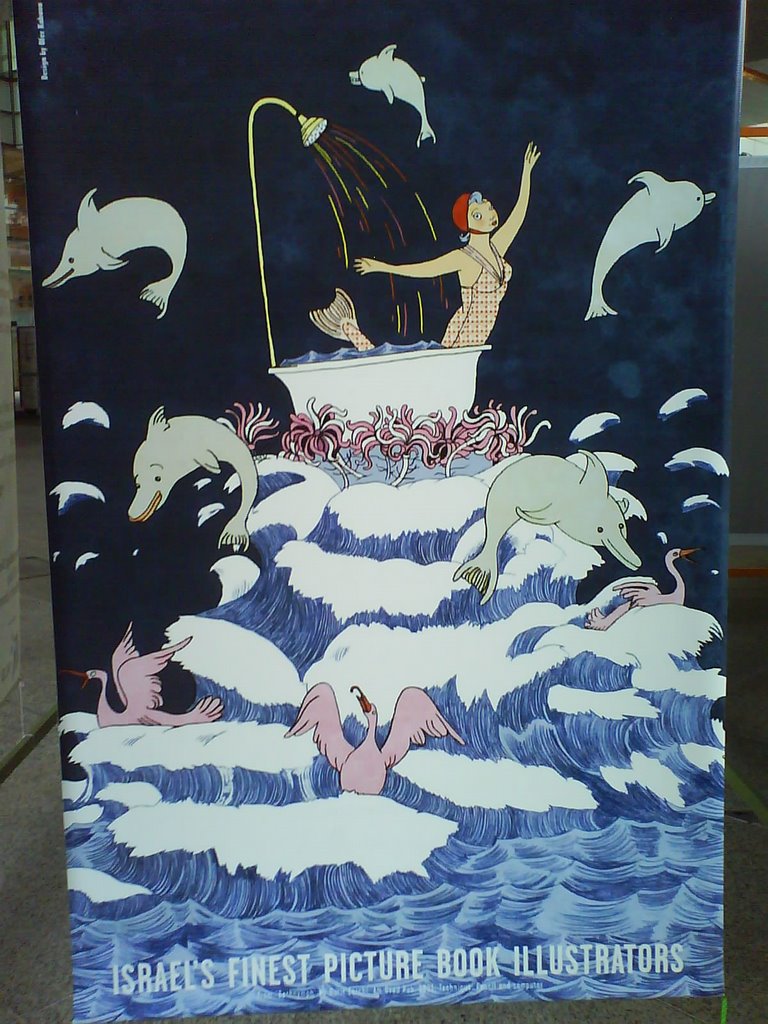
Sefer Festival 2006: Children's Illustrations Exhibition

I took photos of the cooler illustrations at the Israeli children's book illustraton exhibition down at the National Library. Unfortunately my phone's camera couldn't quite capture the illustrator's names at the bottom of each poster, so they'll have to remain anonymous for now.


Read More...

Thursday, August 31, 2006

Used Books A Go Go Baby!

If you walk into a large chain bookstore like Borders or Kinokuniya or even Popular, you probably know exactly what book you want to buy. Or at the very least, you'll know what kind of book. Best-sellers, thrillers, fantasy, science fiction- everything's neatly arranged in rows to make your book purchasing decision as painless as possible. All very efficient, but not very exciting.

Used book stores offer a totally opposite experience. You never know what you'll find on their shelves, where everything's tossed together in a wonderfully dizzy disarray. Familiar authors and titles jump out at you, while unknown ones preen for your attention. At a used book store, book-browsing gains an aura of adventure.

Even in Singapore, where I have yet to find a real dedicated second hand book store, it's possible to find some real gems at stores that stock used books. I passed by such a shop today at Bras Basah. I hadn't any intention of buying a book since I was headed to the National Library, but I couldn't help glancing at the used book shelf (cunningly positioned outside the store) anyway.

To my surprise and delight, a pristine copy of China MiƩville(my current favourite author)'s first novel (and the only one of his I haven't read), King Rat, was sitting on top of a stack of management books on the second highest shelf! To my even greater delight, the book was only selling for two dollars. My buying instinct having been aroused, I examined the other books on the shelves more closely on the off-chance that I might find another steal.

A nineteen year old copy of V.S. Naipaul's A House for Mr Biswas soon revealed itself- I'd always wanted to read the acclaimed author's works and this was the perfect opportunity. Finally, I found David Guterson's Snow Falling on Cedars buried behind a pile of self-help books (the second highest population on the shelf- behind business books!). I'd heard the movie adaptation was excellent, which no doubt reflected on the qualities of the novel itself.

So for the low price of five dollars, I found myself richer by three fine novels. You just can't find a better deal than that in Singapore!

Technorati Tags: , ,

Read More...

Wednesday, August 30, 2006

Sefer Festival 2006 @ Central Library

When I went to the Central Library at Victoria Street yesterday, I was surprised to find an unusually heightened level of security there. Policemen were conducting bag checks at the door leading into the Central Lending Library on the basement floor; there was even a metal detector installed there!

The reason for all these precationary measures was the Sefer Festival 2006, an Israeli book festival being held at the Central Library from the 24th to 31st of August. A librarian handed me a pamphlet as I walked in so I was able to see what it was all about and what I'd missed. It's actually quite an interesting festival, with a diverse range of books on display at the Central Lending Library! I was excited to see books by the Nobel-prize winning author S.Y. Agnon as well as a book titled 'Betzavta (Together) : Guide to teaching democracy through games', which raises the curiousity of the game designer in me.

I was told that a few of the books on display would make their way into the Library's collection, which is very cool indeed. It has often been said that literature is one of the cornerstones of Jewish culture- perhaps no other culture in the world has documented their experiences, problems and triumphs as thoroughly as they have. Through contemporary Israeli literature, I hope to find out more about the culture and lives of the citizens of this nation-state, which is sadly only known to most of us through news reports about the conflicts in which the country has long been embroiled.

The Sefer Festival also focuses on children's literature. If I'd known about the festival sooner, I would very much have wanted to go see one of the festival's events: 'Storytelling Secrets with Noga Algom,' which was held on the 26th and 27th of August. The event was a children's storytelling session; Noga Algom is said to be an accomplished writer and storyteller who conducts sessions for teachers, parents and children in Israel. I've come to be interested in traditional oral storytelling of late so I'd like to see such sessions to observe the methods and techniques of professional storytellers.

There's also an exhibition of children's books illustrations by Israeli artists, which sounds quite promising. I'll go back to the library tomorrow to take a look and snap a few photos. I hope the illustrations on exhibit are as lovely as this one by Ora Eitan (which was thoughtfully given out as a card at the library), created for an illustrated book version of Ella Fitzgerald's song "Tisket-a-Tasket."


Read More...

Tuesday, July 11, 2006

New Readings

The web (in particular, the *ahem* blogosphere) is an important source of information for me but I still hold the humble book, that ancient technology of pulped-wood and ink, in highest regard. From the day I started reading books as a young lad til now, I doubt there's been a week in which I haven't read a book. Indeed, there would be few such days.

Unsurprisingly, I'm a big fan of bookstores and India has, in my opinion, some of the finest such establishments in all of Asia- with diverse selections of books across all genres, often at prices cheaper than can be found anywhere else (and that's not even counting India's famous second-hand book scene, which I have yet to delve into).

I was in Bangalore recently and had the pleasure of visiting a few of it's bookstores. Every time I go to Bangalore I come back with as much books as my luggage can carry- this trip was no exception. However, while my previous previous book-buying sprees in Bangalore yielded mostly fiction and the odd science book, this time I decided to purchase a few choice non-fiction works (though I yielded to temptation and bought a gorgeous new leather-bound collected edition of Robert E Howard's Conan stories).

This change in buying habits was actually inspired by another book that I'd been rading recently-Jeffrey Sachs' inspiring 'The End of Poverty.' Now, despite it's eye-catching title, it's not a book I would normally consider reading simply because of it's subject matter: Economics, a subject I abhorred in junior college (I wasn't particularly bad at it, but I found it tedious and devoid of real-world value as it was taught). How I ended up with a copy of the book was that I was bringing it to a cousin in the Maldives as a gift- she'd been very keen to get her hands on it. Being the curious reader I am, I couldn't resist taking a peek inside en-route.

To my great surprise, I found myself hooked. This was more riveting than 10 airport thrillers put together. Jeffrey Sachs is a more entertaining writer than any economist has a right to be and he argues his case persuasively- that it is within our collective global ability to eradicate extreme poverty (the most extreme form of poverty, where people have no access to basic survival needs such as food, water and shelter) within our lifetimes. A bold claim, certainly, but the man backs it up with weighty (but not ponderous) intellectualism and weathered experience. I won't go into more details (the book is absolutely worth your time- I can't recommend it more) but suffice to say that Mr Sachs has made me deeply interested in economics, a field that prior to this I wouldn't touch with a 10-foot stick- an achievement in and of itself.

My first purchase was another copy of 'The End of Poverty'- this time for my own personal reading. Next, I chose a work that can arguably be called the foundation of modern economic study- Adam Smith's 'The Wealth of Nations.' A cursory reading revealed it to be remarkably accessible, despite it's 1776 publication date. I was also on the lookout for books by John Maynard Keynes, but sadly none turned up.

I did, however, see an interesting contemporary book that invited comparison to Smith's classic text with it's title: 'The Wealth and Poverty of Nations.' This book, by David S. Landes, seeks to explain the great inequalities in wealth that exist between the rich and poor countries of the world today. I haven't touched the book just yet, but it looks to be a thought-provoking read. The last economics-related book I picked up was Thomas L. Friedman's 'The World Is Flat,' a book on that hot-topic of Globalisation that looks to be similarly stimulating.

Finally, I rounded off my purchases with three science books. Charles Darwin's 'The Origin of Species' and Richard Dawkins' 'The Selfish Gene' to start me on the path of filling the woeful gap in biology knowledge left by my formal education and 'Genius'- James Gleick's biography of Richard Feynman- one of the most brilliant minds of the 20th century. I've always enjoyed Gleick's writings- his biography of Isaac Newton was a superlative work- so I have high hopes for this book too.

Further impressions on all these books as I read them!

Read More...

Sunday, June 18, 2006

Online Resume-writing tips and resources

Writing a compelling resume is no easy task. It's not something they teach at school (at least, not at the schools I went to!). Thankfully, there are some really good tips and guides to resume-writing available online.

Rockport Institute, who specialize in helping people choose their career paths, has a really good multi-page article titled 'How to write a masterpiece of a resume.' The article teaches readers how to wriet a resume that markets themselves well and is compelling for employers. Good stuff.


Purdue University's Online Writing Lab has an extensive resume-writing section, including a sample resume and an online workshop.

Montana University's 'Tips on Resume Writing, Interview Skills, and Job Hunting Techniques' page has lots of links to relevant resources online.

Technorati Tags: , ,

Read More...

Wednesday, March 15, 2006

From von Neumann to Ada- the origins of Computer Science

Last week I stumbled upon a blog entry written by Steve Yegge, a former software developer at Amazon.com who now works for Google, titled Math Every Day. In it, he discusses how reading a book called John von Neumann and the Origins of Modern Computing made him realise how important Maths is, especially to programmers, and how a lack of practical Maths knowledge hindered his expertise as one. So he embarked on a program to learn (or rather, re-learn) a bit of Maths everyday for one year.

In his lengthy post, he also details some of John von Neumann's spectacular achievements. Originally a mathematician, von Neumann co-created Game Theory, was a key member of the Manhattan Project that created the first atom bomb, contributed to the field of quantum mechanics, created the field of cellular automata and oh yes, invented the modern computer (in fact, most computers in use today are designed according to an architecture that bears his name). With a resume like that, it's no wonder that John von Neumann is considered one of the greatest geniuses of the 20th century.

Fascinated by the story of this man, I did a bit of googling and found the online text of Tools for Thought, a history of modern computing that focuses on some of the key figures in the field. The book's written by Howard Reingold- who also wrote the critically-acclaimed book Smart Mobs, about the impact that pervasive computing will have on society. The blog associated with the book is one of the best on the Internet.

I read the first chapter of Tools for Thought, which tells the story of Charles Babbage, who invented the world's first working digital computer- the steam-driven Difference Engine, and Ada Lovelace, the daughter of the infamous Romantic poet Lord Byron (author of, amongst other works, Don Juan) and one of the world's first programmers.

Having read that much, I wanted to read more about all these visionaries who stood at the brink of the Age of Information in which we now live. So the next day at the NUS Library, I searched for books on the history of computing and found two rather interesting ones. The first, The Bride of Science: Romance, Reason, and Byron's Daughter, was a biography of Ada Lovelace, which I'm currently reading.

Far from a dry text, the book starts off by detailing the tumultuous romance between Ada's mother- the supremely logical, rational and scientifically-minded Annabella Milbanke- and George Byron- poet, lover, celebrity, a man who would come to symbolize the Romantic movement evermore and become the model for the now-stereotypical Romantic hero.

The book presents Ada as thus being borne of a union between the increasingly-incompatible philosophies of Scientific Rationalism and Romanticism. She would inherit both the wild passions and cold logic of her father and mother, respectively. Set in the backdrop of the emerging industrial Victorian age, her story is one that would quite possibly be considered too outlandish for a work of fiction, and so is yet more remarkable for being true.

The other book I borrowed is Prisoner's Dilemma by William Poundstone. The book is partly a biography of John von Neumann and partly a history of game theory, that branch of mathematics that he helped create. I haven't read it yet, but it comes highly recommended and looks pretty cool.

I personally find that learning about the history of a field- Computing, in this case- and the personalities who helped shape it is far more interesting than simply learning theory without being able to ground it in any kind of context. Pretty much the same goes for Physics, which can seem awfully abstruse to the casual observer but has always been one of the most exciting branches of science, populated as it is by a set of individuals as eccentric as they are brilliant.

Read More...

Sunday, February 26, 2006

A Blogger Blogs about a Magazine Article about Blogging!

Oh the self-reflexivity of it all! Oh and by the way: this is my fourth post today! How unusually productive of me. Anyway, the February issue of New York Magazine's got a cool article called Blogs to Riches: The Haves and Have-Nots of the Blogging Boom, written by Clive Thompson- who runs the excellent science and technology blog collision detection. The article tries to answer the question of why some blogs become really popular and others languish in obscurity, despite the quality of their content.

Well it seems that Clay Shirky, an instructor at New York University who specializes in network theory- which the article describes as "a mathematical model of how information travels inside groups of loosely connected people, such as users of the Web"- studied this phenomenon by analysing 433 blogs and found that a very small number of blogs received hundreds of inbound links (links being the equivalent of popularity votes for blogs) whereas the vast majority of the rest barely had any at all. So we have a very small A-list who get loads of links, a slightly larger B-list (less links than the A-list, but still substantial) and a huge C-list (all us folk who hardly get any links at all *sniff sniff*).

OK so I guess this isn't news to a lot of bloggers out there. What is interesting, though, is that the curve that Shirky obtained by sorting the 433 blogs in order of most linked to least is a power-law distribution- a distribution that is common to many social systems. Shirky thinks that this result can be explained by a simple quirk of human nature- that when we try to choose amongst many given choices (in the case of blogs, a dizzying number of choices), we'll gravitate towards the most popular ones. Which, of course, means that popular things just become more and more popular, and vice versa.

That certainly does seem to describe the "blogosphere," at least to an extent. It also explains why small blogs often try to catch the attention of larger A-list blogs to try and get linked on their front page, which guarantees a surge of attention. There's lots more interesting stuff in the article, but I'm going to cut this post short and send a link to BoingBoing. :P

EDIT: Oh yeah, Clay Shirky's got his own website where you can go if you wanna read more about his research into power laws and blogs.

Read More...

Monday, February 20, 2006

Art in The Age of No-Privacy

I was just looking through a few sites I'd bookmarked recently in order to put up links to them here when I realised all of them had a unifying thread. They were all about the way Internet and surveillance technologies (current and near-future) are eroding away our privacy and freedoms. It's good to see artists (writers, comic artists and animators in this case) tackling these issues that really don't get as much attention in the press as they should. Anyway, here goes.

Online science-fiction magazine Futurismic has a great story up by Mark Ward. It's called Cycle Thieves and it's a deft blend of noir-mystery style cyberpunk and Internet-generation concerns about pervasive social technologies. Very nice and it's apparently his 2nd story, which makes him a ery promising writer indeed.

Wired Magazine's February issue has a nice write-up about the uber-cool artist Paul Pope's upcoming Batman story- Batman: Year 100. I love the man's work- his graphich novel 100%, a character centred science-fiction story filled with beautiful dialogue and even more beautiful art, was just brilliant. So I'm rather looking forward to his take on the Batman myth- set in 2039, Batman: Year 100 posits the character as the last bastion of freedom in a dystopian police state. Which is a bit similar to Frank Miller's take on the character in The Dark Knight Strikes Back, his sequel to the seminal Dark Knight Returns, but I think that given the state of America today (cough*Patriot Act*cough) it's a scenario well worth revisiting. Paul Pope's stated in interviews that he wants depict Batman as a sort of escape artist, fighting the powers that be with dangerous, acrobatic acts of civil disobedience. Whoa, apparently the comic came out last week. Time for me to hit the comics shop.

Animation blog Cartoon Brew linked to a very nice British short animated film titled Welcome To Glaringly. The quality of the linked Quicktime video isn't the best, but the animation itself is gorgeous- utilizing a blocky, pixel-artish look to great effect. This wryly funny short film posits a scenario where video footage from a public surveillance camera is wildly out-of-context, to hilarious (for the audience, anyway) results. The underlying message here, I suppose, is that due to the very nature of public surveillance, it's hard to put any context to such footage and it's necessary to take whatever those cameras see with a grain of salt.

Read More...

Tuesday, January 31, 2006

Ray Bradbury on Writing

Ray Bradbury is one of the true greats. If anyone could be said to have lifted the field of science fiction into the realm of literature, it's him. If he had written Fahrenheit 451 alone, he'd still be considered a master. Thankfully, though, that's not the not the case. His body of work is voluminous and impressive. I've recently been reading his book "Zen in the Art of Writing"- a collection of eleven essays on the topic of, you guessed it, writing. I'm glad I picked it up from the library because it's really quite inspirational. The man has boundless enthusiasm for writing, which stems, no doubt from a similar enthusiasm for life itself. And he communicates this with style and panache. The essays crackle with energy, they're positively infectious.

I'll let the man speak for himself. Here's a choice quote:

"Zest. Gusto. How rarely one hears these words used. How rarely do we see people living, or for that matter, creating by them. Yet if I were asked to name the most important items in a writer's make-up, the things that shape his material and rush him along the road to where he wants to go, I could only warn him to look to his zest, see to his gusto."

I couldn't agree more!

Read More...

Friday, January 27, 2006

Goodbye, Infinite Matrix. You will be remembered fondly.

Infinite Matrix is, or rather, was, one of the most exciting science fiction webzines around. Published periodically from August 2001 to January 2006, it featured short stories by authors including Cory Doctorow, Robert Sheckley (now sadly deceased) and Michael Swanwick. David Langford, who runs the most excellent science-fiction newsletter Ansible , wrote a weekly column for the site, cunningly named the Runcible Ansible (if you don't know what a runcible is, go here to find out!). And before Bruce Sterling started blogging over at Wired, he ran a blog called Schism Matrix on Infinite Matrix for two years.

Yep, there's a lot of good stuff on Infinite Matrix, so it's sad to see the site go. But it's final, January 2006 issue's chock-full of great content. Highlights for me included an essay by William Gibson on how he discovered history and science fiction in his youth (and how the two may be the same thing!) and a new novella (or novelette, as the site describes it) by Cory Doctorow and Charles Stross calledAppeals Court. The site's going out with a bang, that's for sure.

Read More...

Saturday, October 22, 2005

Terry Pratchett's Thud! mini-review

Thud! is the 30th Discworld novel. 30! That's a lotta novels. Remarkable then, that Terry Pratchett has managed to keep the fires of his creation so strong through all this time. In fact, I think this latest one's absolutely brilliant. It's a cracking read- I devoured in less than 2 days- and also scarily prescient as it tackles the currently rather-sticky issue of ethnic warfare and ideological fanaticism. At the same time, we get to see a new side of Samuel Vimes' (commander of the City Watch and star of some of the best Discworld novels) character as he's pushed to his absolute limits by the investigation in this book while at the same time attempting to be a good father to his baby son. Both aspects of the book are developed simultaneously and collide in a rather exciting finale. Speaking of which, Thud! has one of the best endings of any Discworld book. One thing I love about the Discworld series is how Pratchett evolves the world with every book. And the events at the end of this one shake up the status quo with great aplomb. Absolutely brilliant.

Read More...

Tuesday, September 13, 2005

Salon.com's serializing Cory Doctorow's new novel!

This is very cool. Cory Doctorow is, I feel, one of the best talents in science fiction, nay, all of fiction, today. And he's a really cool guy to boot- releasing almost all his stories online under Creative Commons licenses which allow free non-commercial redistribution. He's finished a third of his new novel, tentatively titled Themepunks, and Salon.com will be publishing a new section of the book every Monday for the next ten weeks. The 1st part is online here. Have a taster:

"Why the hell have you done this, Landon?" Kettlewell asked himself into his tie-mic. Ties and suits for the new Kodacell execs in the room, like surfers playing dress-up. "Why buy two dinosaurs and stick 'em together? Will they mate and give birth to a new generation of less-endangered dinosaurs?"

Read More...

365 tomorrows

365 tomorrows is a project by a group writers to publish a new science fiction short story every day for one year- it began on August 1st 2005. They've put up some really neat stories.

Here's an excerpt from the story for September 1st, Time To Remember:

Don’t wake up yet, Mischa. Please, please don’t wake up.

At nineteen, Christopher Malloy was the youngest person on Io to receive his degree in neuronanotechnology. It was quite an accomplishment, according to his parents and teachers and friends, but at that moment, on the sunken platform of the medical arena, Chris felt as small as the machines he worked with. Seven professors, nine technicians, two medical journalists, and one blinding halogen light glared from the space overhead, waiting for him to make a move.


(via BoingBoing)

Read More...

Sunday, September 11, 2005

Singapore Writer's Fest: Creating Online Communities Through Blogging

This talk, held on the final day of the SWF, was really fun. Not only did I get Cory Doctorow to sign a copy of his new novel, Someone Comes To Town, Someone Leaves Town (which I bought from Borders an hour before the talk!), the talk itself was very entertaining and quite informative! It was a 4-way talk with Cory Doctorow and Singaporean bloggers mrbrown, Mr Miyagi and the (in)famous XiaXue. Mr Brown was the unofficial "head" of the talk but everyone had something interesting to say. The talk was in the form of a question and answer question so there was plenty of audience interaction.

Got more- click lah!

Highlights:
mrbrown introduced the Singapore blogging community that they started- Tomorrow.sg, a link blog which he said was modelled after the blog that Cory writes for, BoingBoing.net. Not a bad model since BoingBoing's the most popular blog on the Net! He spoke of a controversy they had recently where they posted a link to a single unwed mother's blog (it's this post here) and she got loads of unwanted publicity as a result and her boyfriend was slammed left and right for being a jerk. There was a big uproar with people saying that Tomorrow.sg shouldn't just link to blogs anyhow without permission. Cory chipped in that the Net was "made for linking without permission" and people shouldn't post information on a public medium, which a blog is, if they intend it to be private. Besides, Livejournal lets you publish private, password-protected blogs- so if you want to publish a private diary online, use one of those to make sure nobody else reads it!

Tomorrow.sg's policy now is that if a blog has a notice saying permission is required to link, then they'll ask for permisson (amusingly, Cory chipped in that he'd link without asking for permission anyway!). If not, they'll take it for granted that it's OK to link to the blog. Sounds fair enough. Here's their linking policy in full. Still on the topic of privacy on the Net, Cory recommended this insightful piece by blogger Danny O'Brien. The piece is basically about the kinds of conversations people have on the web (particularly on blogs) and the differences between public register- what you say for public consumption- and private register- like conversation between friends.

Later, someone asked a question about government intervention in the blogosphere here. So far, the speakers said, the government hasn't done anything drastic with regards to blogs, even those with political content- they're content to take a wait and see approach. mrbrown did relate a funny anecdote about a photo of 2 policemen asleep in their car that he put up on his blog- apparently the Chief of that police division came to his house and politely asked him to take down the photo as it negatively affected morale in his division. Apparently this is the only time mrbrown was ever approached by a public official with regard to content in his blog. He did stress that they didn't force him to take down the photo, merely requested it while explaining to him the reasons why they didn't want the photo up.

Another interesting topic of conversation was how bloggers respond to criticism. Xiaxue mentioned that some bloggers get quite upset- and even in her case there's often quite a lot of negative comments on her posts (a lot of people hate on her cos her blog is so popular. It's not really my thing but I don't see why the hating) but she also has quite a lot of supporters who defend her.

Oh yeah! Mr Miyagi's put up a few clips from the talk up on his blog! Specifically, the clips on this post and this post. The first is a hilarious clip of this Mystical Indian Dude (as me and my sister dubbed him cos of his propensity to speak in flowery, deep-sounding language) talking about how opinions are ants. And blogs are honey. Yes, really. He's actually got an interesting point hidden in his multiple metaphors. The reactions from the panel were something to see whenever he spoke. Everyone just did a double-take, a kind of "did he really say that?" moment. He also chipped in with the last comment of the day. Can't remember the details, but he was talking about how blogging is a kind of stress-reliever and somehow ended up talking about Laughing Clubs, the ones they have in India where lots of middle-aged men gather in parks and laugh their worries away as a group. The second clip is of Cory talking about how you can choose to focus on new content for your blog or focus on interacting with your readers.

And that's it for this year's Singapore Writer's Fest! The talks I attended were all quite excellent so I'm really looking forward to next years one. The organisers did a really good job, well, organising the whole affair so kudos to them, too!

Read More...

Thursday, August 25, 2005

The Singapore Writer's Fest starts tomorrow!

I'm a bit duh when it comes to things like festivals here in Singapore but when my sister told me that Cory Doctorow (my current favourite writer!) is coming to the Singapore Writer's Festival, I sat up and took notice. So this festival... looks pretty cool, actually. Not only will Cory Doctorow be there, so will Bruce Sterling- one of my all-time fave science fiction authors. The mind reels. The idea of getting to see these two literary luminaries in person boggles my mind. I've never actually met any of my heroes... Well there's a first time for everything. Now if they'd gotten Neal Stephenson to come down too it'd be a 3rd strike and I'd be out... cold (gah... what a horrible mixing of metaphors I have attempted).
I think I'll attend all the free talks on Science Fiction / Fantasy as well as the talks on Writings in Cyberspace. Kinda the obvious choice for a blogger I figure. Plus I guess I should really try n be part of the big Singapore blogging community. I only actually read Mr Brown n Mr Miyagi's blogs... but I could make more of an effort to see what else is out there that's cool.
Oh yeah, back to the fest. The talks on Graphic Novels should be interesting. I'm crazy about comics after all. Tho sadly I have no idea who the speakers are for those talks.
All in all, the coming week should be damn interesting.

Read More...

Monday, July 11, 2005

Writer's Block

Lightning and thunder. Rain wails down on the ground unmercifully. Torches burn in the night. An angry mob, complete with pitchforks and torches. Ah, tradition.
A man points his finger at a point above his head and yells, "There he is!" The crowd, like a hydra, moves its many heads in unison and looks up. A tower, tall and thin like a finger growing out of the ground, with a single window at the top. Inside, the silhouette of a man is visible, lighted by a table-lamp that swings wildly in the wind. He is seated at a table.

Free of such encumbrances as gravity or even legs, we omniscient, invisible observers are free to swoop up through the window and into the room, to better observe what he does.

As we look down on him from a vantage point at the top of the room's conical ceiling, we see a layer of crumpled-up pieces of paper covering the floor. They rustle like leaves with the wind. The man at the table has another piece of paper in front of him, held down with one hand while the other grasps a pen. It hovers inches above the paper, unable to make contact. After a few minutes of this our would-be writer screams, frustration and anger in his voice, and rips the paper apart. He gets up, grabs piles of paper with both his hands and begins to hurl them out the window.

Below, the mob has reached the foot of the tower. The thrown paper, mulchy with rain, falls on them like so much snow. They aren't bothered. Their hive-mind operates at another level. Focused on the task at hand: breaking down the tower gates. A previously unseen log emerges from the thick of the crowd, held up on each side by a couple of swarthy men.

They charge at the door.

BAM.

Again.

BAM.

And again.

BANG.

The gates crash inward, shattered wood flying everywhere. The men drop their improvised battering ram. They stand at the bottom of a hollow shaft. A narrow staircase hugs the walls, winding up to the very top. It stops in front of a trap-door built into the wooden ceiling of the shaft. The mob shifts into caterpillar mode and begins its trek up to the top.

The writer at the top still rages, wordlessly screaming out his window at the uncaring rain. The first to reach the top begin banging on the trap-door. He scarcely notices. It's only when they finally slam it open, sending a clump of wet papers flying, that he turns around to face the first of the crowd as they climb up into his room.

They are all quiet now. Then one of them steps forward. He looks like a hobo, dressed in rags, a years-worth of beard hanging down to his chest, dripping water onto the floor. He coughs, as if to clear his throat. He opens his mouth, and speaks. His voice booms, louder even than the rain and thunder.

"Your head's like mine, like all our heads, big enough to contain every god and devil there ever was. Big enough to hold the weight of oceans and the turning stars. Whole universes fit in there!"*

He steps forward with every sentence and is now right in front of the writer, who trembles. He pokes his finger in the writer's chest and continues.

"But what do we choose to keep in this miraculous cabinet? Little broken things, sad trinkets that we play with over and over."*

The writer has sunk to his knees. He weeps openly, tears run down the sides of his face.

"The world turns our key and we play the same little tune again and again and we think that tune's all we are."*

The writer howls, part-agony, part-grief.

"There, there, we'll soon fix you up."

For a second, the world seems to bend at the edges. The hobo is transformed. He is light-clad, resplendent. He reaches out and touches the writer's head. His essence pours into the writer and he disappears into him.

One by one, the remaining men in the room are transformed. In their stead stand a werewolf, a unicorn, a Viking warrior with a magic hammer. They jump into the writer's head after the hobo.

The crowd below surges forward into the room and the line of people, transforming into wondrous and fantastic creatures and places, leap into the writer.

Mermaids, dragons, elves and fairies.
Brave samurais and knights of yore, riding steeds.
A procession of Lovecraftian creatures of nightmare and horror.
Gaudy and colourful costumed heroes and their similarly costumed foes.
Gaseous djinns and watery sprites.
Talking rabbits, talking mice.

All these creatures flood into the writer's head as he sits on the floor, open-mouthed. Finally the last one enters. The writer blinks. And the world is transformed.

No more tower. No more lightning and thunder. No more rain. Nothing but empty whiteness and the writer at the centre of it all. He raises a pen as large as the universe. He begins to write on the canvas of his imagination.

And so the story begins.

*These lines of the hobo’s speech are quoted from Grant Morrison’s Invisibles. An observant Invisibles fan will notice that the hobo character is actually Tom O'Bedlam himself. ;-)

Notes: This is the first of hopefully many short stories I'm going to post to this blog. I hope everyone who reads it finds it at least mildly enjoyable. Or at least not completely revolting.

Shoutouts to the blog No Fancy Name for the extremely useful post on making expandable blog posts in Blogger without which I would have to resort to using the fairly useless code given in Blogger's Help to implement this nifty function.

Read More...